Case study · client project · research and strategy

Genhouse

The plan was a paid listings hub. Then I asked designers what they actually needed.

RoleUX designer (contract). I led the research.
Team4 UX designers including me (one also ran the project), a data analyst, and the founder
Research30 survey responses, 5 interviews, 4 competitors
StatusResearch complete. Development paused. Not launched.
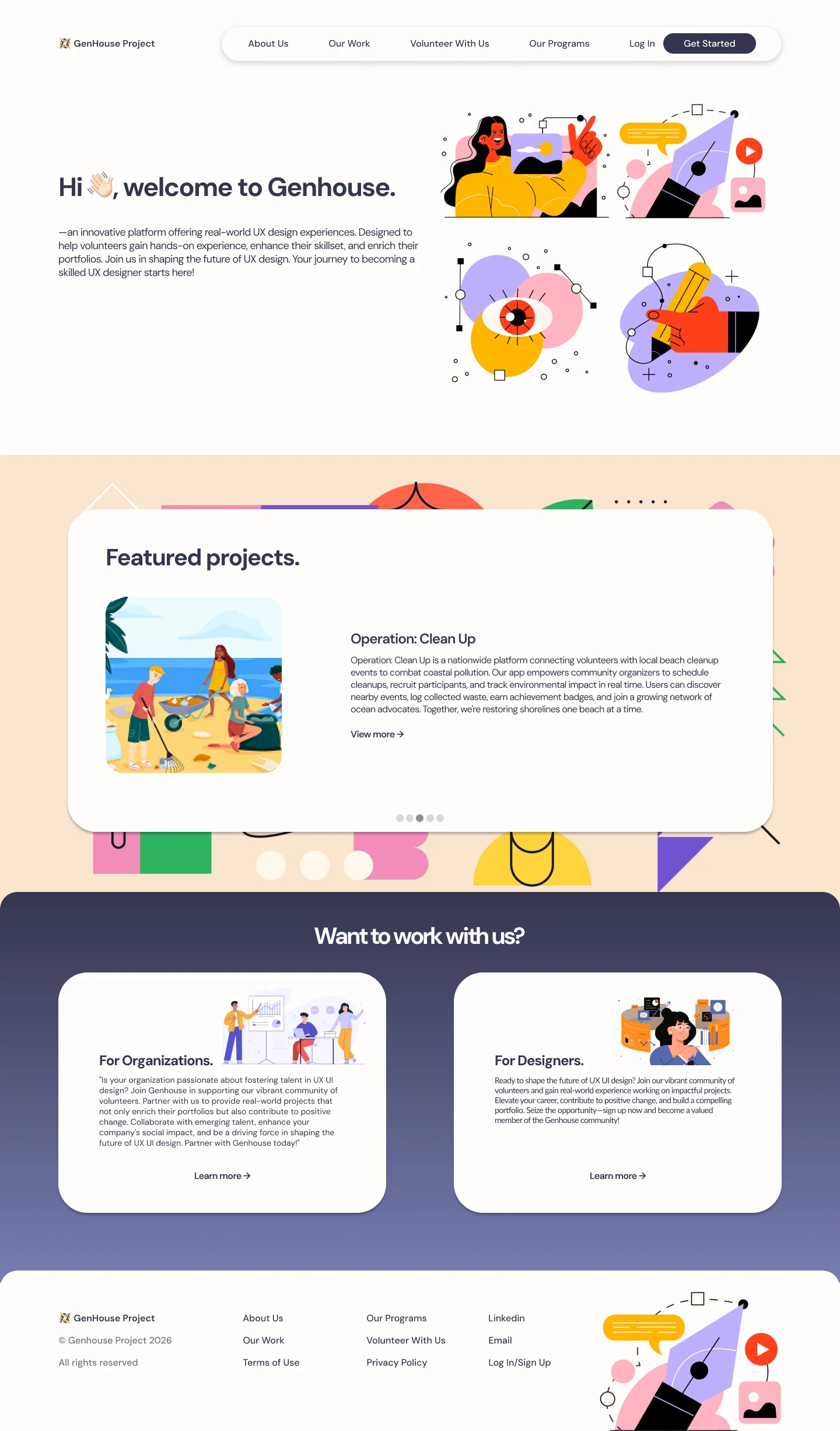
Genhouse homepage design: a welcome message, a featured projects carousel, and two entry points, one for organizations and one for designers

The Genhouse homepage, which I designed in Figma. Scroll inside the frame.

The short version

A reasonable idea that the research didn't back.

The plan

Sell access

Genhouse connects early-career designers with nonprofits. The founding bet was that designers can't find real projects, so they would subscribe to a hub that lists them.

The catch

Listings were not the problem

Half the designers I surveyed had already done client work, and the people I interviewed knew where to look. What they could not find was work that was scoped, supported, and worth showing.

The turn

Sell credibility

I recommended structured, mentored projects in place of listings. That went into the product requirements. Then the project paused before anything was built.

What I did

My part, start to finish.

Plan

Wrote the research plan and what success would look like.

Ask

A 38-question survey with 30 responses, 5 remote interviews, and a SWOT on 4 competitors.

Check

Built the analysis in pivot tables, then had our analyst confirm it in SQL. I did not want a product decision resting on my spreadsheet.

Translate

Turned findings into product requirements, a persona, and a sitemap with the team. Then I designed the homepage.

Present

Took it to the founder, including the part nobody wanted to hear.

Who answered the survey (30 people)

Entry level 12Junior 7Student 632

12 entry level (0 to 1 years), 7 junior (1 to 3 years), 6 students, 3 career switchers, 2 mid-level. 14 had only personal projects, 9 had paid client work, 6 had unpaid client work, and 1 had none.

The findings

Four things the data kept saying.

"I want to feel like my work is actually being used, not just sitting in a folder."Interview participant, describing their ideal volunteer project.

13 of 30

Real experience was the wall

It was the biggest challenge by a wide margin, more than double the next one. 27 of 30 also said they have felt intimidated posting their work publicly.

Biggest challenge as a designer right now

Getting real experience13
Building confidence6
Getting interviews5
Getting feedback3
Understanding UX expectations3

One answer each, 30 respondents.

Stakes beat effort

Confidence came from being accountable

I asked how confident people were that their portfolio shows real UX skill. Paid client work scored highest. Unpaid client work still beat personal projects. The groups are small, so I read this as a direction and not a proof.

Average portfolio confidence, 1 to 5

Paid client work (9)3.8
Unpaid client work (6)2.8
Personal projects only (14)2.4

Group sizes in brackets. The one respondent with no projects is left out.

17 of 30

Mentorship was what portfolios were missing

More people named mentorship feedback than real clients. 18 of 30 rated how supported they feel as a junior at 1 or 2 out of 5, and half had never had a formal mentor. In the original plan, mentorship was a later add-on.

What is missing from your portfolio?

Mentorship feedback17
UX process documentation15
Real clients14
Case study structure13
Research experience10

People could pick more than one. Bars are out of 30.

$11-25

They'd pay, with conditions

24 of 30 were open to a subscription. Of those 24, 15 picked $11 to $25 a month and one picked $50 or more. In interviews the condition was always the same: mentorship or a structured program, never listings alone.

Would you pay monthly for real projects plus mentorship?

Yes 14Maybe 10No 6

Price that feels reasonable (the 24 who said yes or maybe)

$11 to $2515
$0 to $108
$50 or more1
The interviews

Five designers, the same three complaints.

I interviewed five designers who had looked for volunteer UX work, from a recent bootcamp graduate to someone with four years at an agency. Finding postings was easy for all of them. What came after was the problem.

"It is easy to find postings, but hard to find well scoped ones."

Designer who moved over from graphic design

Access was never the gap. Several named the same platforms and said the listings were vague or asked for too much.

"Only if it came with mentorship or a structured program, not just access to listings."

Bootcamp graduate, on what would make paying worth it

Payment was tied to mentorship. Four of the five gave some version of this answer. One compared it to a fellowship.

"The scope expanded after, so I had to set boundaries."

Designer who came to UX through a class project

Scope kept moving. Shifting timelines, vague scope, and calls with no agenda came up again and again.

"Vague posts are usually a red flag."

Designer who moved over from graphic design

They already vet projects themselves. A real website, a named contact, and clear time needs were how people judged whether a project was legitimate.
The persona

Sam, who has done the searching already.

Illustration of a person holding a magnifying glass over a bar chart

Sam

New to product design. Works a non-design job.

"I want to feel like my work is actually being used."

The situation

Sam wants volunteer work that builds a portfolio and helps an under-resourced organization. They have found some through Catchafire and UX Rescue, but struggle to judge a posting's time commitment and needs before saying yes.

Wants

  • Real, launched projects
  • A full-time design job
  • Cross-functional teamwork
  • To help underfunded organizations

Needs from a project

  • Mentorship from working professionals
  • Real stakeholder constraints
  • Defined structure
  • A flexible timeline
  • To learn from other designers

Where Sam looks now

  • Catchafire
  • UX Rescue
  • Behance
  • Dribbble
  • Upwork
  • Fiverr

Built with the team from the interviews and survey.

The competition

Four places designers already go, and what each leaves out.

BehanceDribbbleFiverrUpwork
What it isPortfolio showcase, backed by AdobeShort visual posts and a job boardFreelance marketplace with priced packagesFreelance marketplace with proposals and contracts
Good atGetting polished work seenVisual trends and curationFast, cheap hiringHuge demand, payments handled
Where juniors fall throughNo mentorship. Finished work only.Surface-level. No room to show UX process.Juniors underprice themselves. No career structure.Heavy competition. Costly to get noticed.
Opening for GenhouseGuided growth and real outcomes, not conceptsLearning and impact over looksNo price competition, skill growth firstA home for volunteer UX work

Condensed from a full SWOT on each.

The disagreement

The founder wanted revenue fast. Fair. The data wanted something slower.

This was not a tidy research-to-handoff story. Timelines were slipping, the team was spread out, and everything was on fire a little bit. My recommendation didn't change. How I delivered it did: numbers first, tradeoffs said out loud.

What the founder wanted

  • Launch the listings hub and get subscribers quickly.
  • Add mentorship in phase two.
  • Prove people will pay first, add structure later.

What the data said

  • Listings alone won't convert. People already have listings.
  • Mentorship is the condition people put on paying.
  • 23 of 30 wanted projects that are somewhat or very structured.
The shift

From selling access to selling credibility.

Before research

Listings hub

Pay a subscription, browse nonprofit projects. Assumes access is the problem.

After research

Structured, mentored projects

Vetted nonprofit partners
You know the work is real and someone answers for it.

A written brief
Scope, timeline, and deliverables agreed before you start.

Stakeholder check-ins
Regular touchpoints, the way a real job works.

Something to show
Every project ends with a piece you can talk through in an interview.

What "vetted" would have to mean

Lack of guidance and unclear scope were two of the top three worries about nonprofit work, so I mapped what Genhouse would check before putting a designer on a project. These are working notes. Open questions are marked.

Before a project starts

  • One dedicated, named point of contact
  • A defined role, weekly hours, and a confirmed project window
  • An existing website, plus any past audits or research
  • Does the contact have experience in the field? open
  • A tested business plan? open

While it runs

  • Stakeholders show up to meetings
  • Deadlines and tasks tracked in one shared dashboard
  • A progress bar for designer updates

After

  • An evaluation of how it went
  • A post-project rating system? open
The structure

The site we mapped, with two front doors.

Organizations and designers each get their own dashboard after signing in. Everything a visitor needs before that sits one level down from the homepage.

Home
About Us
Our Work
  • Meet Our Designers
    • Designer Profile
      • Project Case Study
  • Featured Projects
    • Project Case Study
Volunteer With Us
  • All Open Projects
    • Project Description
Our Programs
  • GP Digital Solutions
  • GP Labs
  • LCC
Sign Up / Log In
  • Company Dashboard
    • Posted Projects
    • Applications Received
  • Designer Dashboard
    • Profile
    • Active Projects
    • Saved Projects
    • My Applications
Primary pageSecondary pageFeature page
What happened next

Then it paused. Here's what I can and can't claim.

People on the team moved on and there was no budget for developers, so Genhouse never launched. I can't show that the new direction works. I can show that the research caught a shaky assumption before anyone paid to build on it.

If it restarted, I would pilot the mentored-project idea small, with one nonprofit and a few designers, before designing a whole platform. I would also go back to the people who said they would pay and put a real price in front of them. Thirty survey responses and five interviews are enough to change a plan. They are not enough to set a price.

What I took with me: holding a position with evidence while the ground is moving is its own skill. And a finding only lands if I deliver it well.

Next case study Echo Social media without the performance →